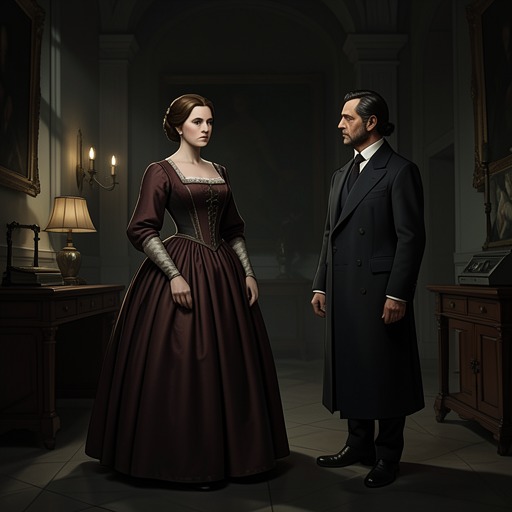
Anne de Bourgh
Just DesertsAnne de Bourgh occupies a largely silent position within the family politics surrounding Fitzwilliam Darcy, yet that silence gives her social situation considerable weight. She is the daughter of Lady Catherine de Bourgh, the cousin of Darcy and Richard Fitzwilliam, and the heiress to a large estate. Her importance in the plot comes less from independent action than from the expectations imposed upon her: Lady Catherine treats a supposed childhood engagement between Anne and Darcy as an established family duty, while Darcy insists that neither Anne nor he is bound by an arrangement that was never confirmed by their parents or recorded in any document.
Identity and Family Position
Anne is introduced as Darcy’s quiet and shy cousin. When Darcy and Richard Fitzwilliam arrive to visit Lady Catherine de Bourgh and Anne, Darcy deliberately addresses Anne with warmth, observing that it is good to see her looking well. He then withdraws with Richard to wash away the dust of the journey, leaving Anne in the room with her mother. The small exchange distinguishes Anne from Lady Catherine: Anne returns Darcy’s gentle smile, while her mother dominates the household through accusation, command, and verbal force.
Anne’s status is also economic. Elizabeth Bennet explains that Anne is the heiress to a large estate, a fact that would make her an attractive marriage prospect in the calculations of the upper class. Elizabeth contrasts Anne’s position with that of Richard, the second son of an Earl, who would benefit from marrying a woman with a significant dowry. In that social arithmetic, Anne is treated as an estate and inheritance as much as a person. Elizabeth also notes that Anne’s family closeness to Richard would make a match with him inappropriate, even though her wealth would otherwise make her ideal for him.
The Supposed Engagement to Darcy
Lady Catherine de Bourgh presents Darcy’s courtship of another woman as an outrage because she believes him already betrothed to Anne. She claims that the union was the dearest wish of Anne’s mother and Darcy’s mother, and demands that Darcy perform his duty immediately. Her argument relies on family intention, rank, and the idea that a marriage joining two branches of the family should take precedence over Darcy’s own choice.
Darcy rejects the premise. He states that he is the head of his own family and denies that he is a Fitzwilliam in the sense Lady Catherine invokes, then makes the decisive point that neither he nor Anne is bound by the alleged arrangement. He has never heard either of his parents mention or confirm any childhood engagement. There is no documentation or paperwork, and Darcy is suspicious that the story was not raised until after his father’s death, despite having gone unmentioned during the decade after his mother’s death. The lack of evidence turns the supposed engagement into a family claim rather than a binding agreement.
Darcy further refuses to speak privately with Anne about the matter. He tells Richard Fitzwilliam that he has not been alone with her for years and does not want to give Lady Catherine even the slightest opportunity to claim that a private conversation has created a compromising situation. Consequently, Anne is not informed beforehand of Darcy’s rejection; Darcy intends the first public notice to be the announcement in the Times. His strategy protects his own position, but it also shows how little direct agency Anne is allowed within the dispute. Her name is used as the basis of the demand, while the adults around her manage the consequences without consulting her.
Relationship with Lady Catherine and Darcy
Anne’s relationship with Lady Catherine is marked by maternal protection and control. Lady Catherine had excessively mothered Anne after Anne suffered scarlet fever as a child, and the illness appears to have intensified her mother’s determination to supervise her life. The proposed marriage to Darcy is therefore not merely a social preference: it is part of Lady Catherine’s attempt to secure Anne’s future, preserve family unity, and direct the succession of property and rank.
Darcy’s relationship with Anne is more considerate but distant. He greets her kindly and is pleased to see her looking well, yet he has spent years avoiding private circumstances that could be manipulated by Lady Catherine. He does not describe a romantic bond with Anne, and he rejects the notion that family descent from the previous Earl of Matlock automatically creates an obligation between them. His refusal is directed principally at Lady Catherine’s coercive interpretation of family duty, but it also prevents Anne from being treated as the inevitable recipient of a marriage she has not chosen.
The conflict is complicated by Darcy’s emerging courtship of Elizabeth Bennet. Lady Catherine hears that Darcy is courting someone in London and interprets the relationship as a betrayal of Anne. Elizabeth later explains that Darcy had been courting a Miss Bennet before Elizabeth returned to Grenadine Reef, and that after she came back to London after Michaelmas she was Lady Pentland. This clarification connects Anne’s position to the book’s recurring concern with concealed identity, social rank, and the way women are described through men’s marriage choices.
Illness, Isolation, and Later Life
Anne’s later circumstances are shaped by her mother’s illness. During a journey disrupted by a snowstorm, Lady Catherine is forced to remain at an inn, where she develops pneumonia. She recovers enough to be taken to London for Christmas, and Anne is summoned from Rosings Park to join her mother and the Earl’s family for the season. The arrangement suggests Anne’s continuing dependence on the family network and on Lady Catherine’s health.
After Twelfth Night, Anne and Lady Catherine return to Rosings Park. By then Lady Catherine’s lungs have been seriously weakened. She becomes easily breathless, and attempts to rant provoke coughing fits; her once-loud authority is reduced to a wheeze. When news arrives that Darcy has married Elizabeth Bennet, Lady Catherine is confined to bed, sending vicious letters that receive no reply. Anne remains associated with her mother through this final period, while Lady Catherine’s physical decline removes much of the force behind the demands that had once treated Anne’s marriage as a matter of family command. Lady Catherine dies in the winter of 1814, leaving Anne’s future less visibly directed by her mother but still marked by the expectations attached to her inheritance.
Narrative Function and Significance
Anne de Bourgh functions as the human center of an arrangement that others repeatedly turn into a political instrument. Her estate makes her valuable; her family connection makes her marriage symbolically useful; her illness and quietness leave space for Lady Catherine to speak on her behalf. Yet the narrative refuses to confirm that Anne herself wants Darcy, or that she ever consented to the supposed engagement. The absence of her voice is therefore meaningful rather than neutral: it demonstrates how a woman’s property and family position can be discussed publicly while her wishes remain unrecorded.
Her role also sharpens the contrast between marriage as partnership and marriage as dynastic management. Lady Catherine sees Darcy’s union with Anne as a duty that would unite two branches of the family. Darcy sees the alleged agreement as legally and morally empty because it lacks parental confirmation and documentary support. Elizabeth’s account of Anne as a wealthy heiress reveals the broader social machinery behind the dispute: rank, estates, dowries, titles, and connections determine what families call an eligible match. Anne is not the villain of this arrangement and not its active conspirator. She is its most important absent voice, a woman whose supposed betrothal exposes the coercive assumptions built into the family’s understanding of marriage.